

 |
 |
 |
|
 |
|
 |
|
 |
|---|
|
Edward Van Halen's gear PEAVEY 5150-II HEAD
Despite the lead singer hoopla that may be brewing in the Van Halen camp at any given moment, the name "Edward Van Halen" still draws a good deal of attention. So when it was announced that Peavey and Eddie had teamed up again to whip up a brand-spankin' new 5150 amplifier, guitar fans worldwide were clamouring to get a peek (or should we say a listen) of the new creation.
 Such was the case at the annual NAMM (National Association of Music Merchants) event in Los Angeles. When Edward appeared at the Peavey booth to debut a prototype of the 5150-II, hundreds upon hundreds of show goers crammed themselves around the cubicle attempting to catch a glimpse of the renowned guitarist and his wares. NAMM attendants claimed to be blown away by the otherworldly sounds emanating from the booth (hey, it doesn't hurt to have Eddie Van Halen playing through the amp. Shit, he could jam through a Radio Shack amp and still make it sound amazing...). Hopes were high for Edward's latest "masterpiece". Then the release date had gotten pushed back several months, frustrating those would like to test drive it ourselves. Now that we have, is it worth the wait? Well... Before we get to the nitty gritty, let's see how it's different from the original 5150. The first amp housed a standard four 6L6 power amp tubes, and so does the II; but while the 5150 contained only five 12AX7 preamp tubes, the 5150 II adds one for a total of six 12AX7's. The 5150 featured a three-band EQ, whereas the 5150 II has two such EQ's (one each for the rhythm and lead channels) for better fine-tuning. There are separate Resonance and Presence controls for the rhythm and lead channels on the newer model, while the previous possessed only one set of such controls. The two models share the same bright/crunch controls (on the rhythm channel) and pre/post gain controls (both channels). The 5150 II allows the user to turn the crunch option on and off with the footswitch (a handy plus), while the other didn't. The 5150 offered two input jacks, but the 5150 II only has one (Peavey and Edward did this for some reason or another; perhaps because of lack of room on the amp's front?). Both models have virtually the same rugged casings; so if you view each one "from the knobs up", you can easily mistake the two for each other. That last statement can apply to their lead channel sound, as well. Sorry, folks; I cannot tell any difference between the two. I'm not implying that it's bad in any way. In fact, it's rather good; the first 5150 amp absolutely cranked with a badass, ball-shaking, tear-your-head-off-and-shit-down-your neck tone that most players search for all their lives. One may ask, why bother purchasing the II if there's no tonal differences or improvements? There's a case in the rhythm channel: the sound is practically identical to the first 5150's clean sound (admirable, but no where close to being as incredible as an amplifier like the Carvin Legacy amp), yet you have more power to make minute changes in the sonic output. If that's something you'd want, then go for it. Most Van Halen fans will be playing through the excellent lead channel anyhow, so the rhythm channel's expanded controls will matter little. The advice is: if you already own a 5150, don't bother laying down your hard-earned cash for a 5150 II, it's just not worth it for minor refinements. If you own neither one, on the other hand, go with the II; you'll never know when you might want a bit more governance over your tone. The amp specs are:
 Front view: 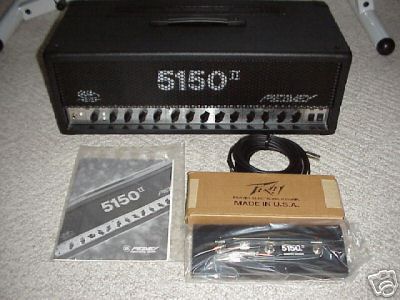 Another front view:  Inside the paper box:  Beneath the dust cover:  |